
As 2025 draws to a close, which terms have garnered widespread attention over the past year? Based on samples of key emergency management work and hot public opinion in 2025, we have summarized and analyzed the following annual hot topics. Let's take a look.
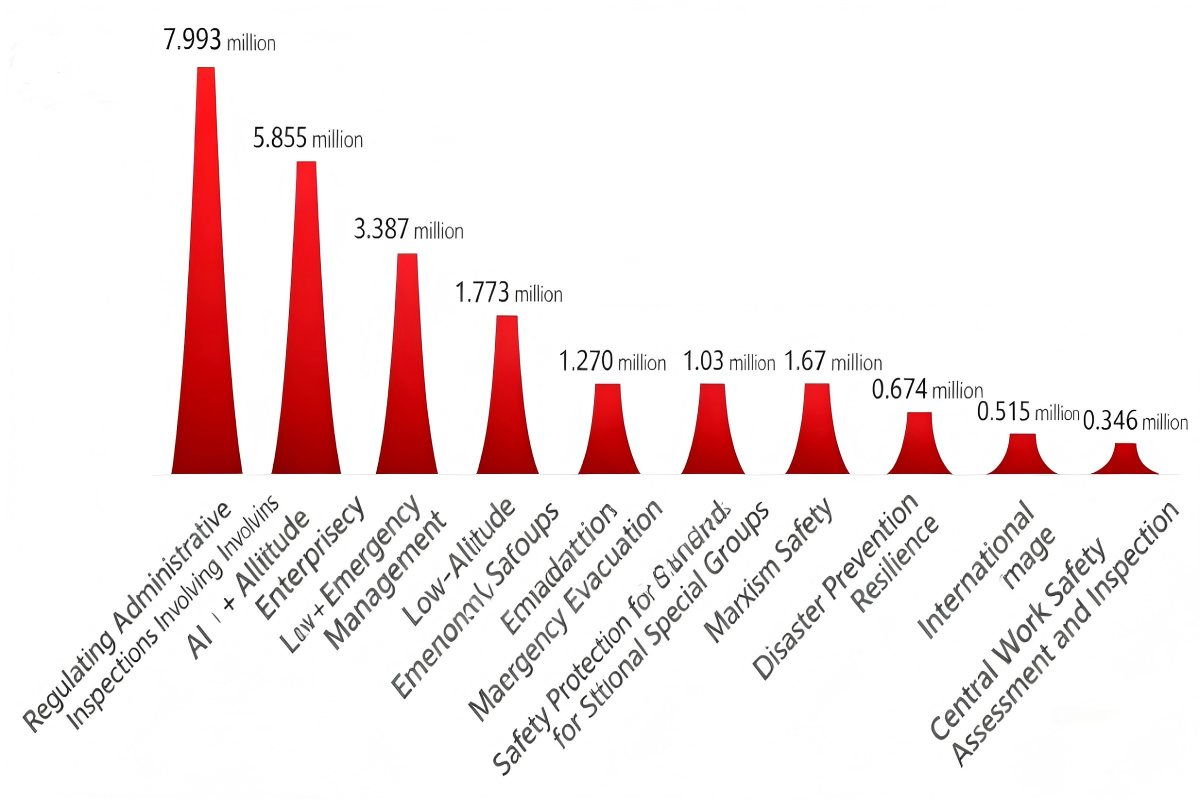
(Data source: Big Data Public Opinion System of China Emergency Management News Agency)
TOP 1: Regulating Administrative Inspections Involving Enterprises
- Heat Index: 7.939 million
In 2025, local governments thoroughly implemented the Opinions of the General Office of the State Council on Strictly Regulating Administrative Inspections Involving Enterprises and earnestly carried out special campaigns to standardize administrative law enforcement involving enterprises, achieving positive results. With the issuance of the Administrative Law Enforcement Supervision Regulations, the release of typical cases of the special campaign to standardize administrative law enforcement involving enterprises, and the successive introduction of local regulations and rules, public attention to regulating administrative inspections involving enterprises has continued to rise.
Throughout the year, public opinion has shifted from worrying about distorted law enforcement to having greater confidence in standardized law enforcement. Public opinion calls for continued efforts to correct typical individual cases and promote the standardization of similar cases, and on this basis, strengthen the training of grassroots law enforcement personnel. Currently, there is a consensus in public opinion that only when enterprises truly feel the effectiveness of the system and services can law enforcement involving enterprises promote enterprise production and economic and social development, and truly embark on a "path of safety" and "path of the rule of law." This is also the joint force of public opinion that promotes the continuous deepening, solid progress, and effective results of regulating law enforcement involving enterprises.
TOP 2: AI + Emergency Management
- Heat Index: 5.858 million
Currently, artificial intelligence (AI) technology is rapidly and extensively integrated into social production and life as well as national governance, injecting new vitality into the cause of emergency management. Against the background of promoting the efficient integration of new-quality productive forces with new-quality combat effectiveness, empowering emergency management with AI has become an important work direction.
In August, the State Council issued the Opinions on Further Implementing the "Artificial Intelligence +" Action, clearly proposing to strengthen the application of artificial intelligence in work safety supervision, disaster prevention, reduction, and relief, public safety early warning, social security management, and other fields. All units in the emergency management system, based on actual work needs, have actively explored innovative paths for "AI + Emergency Management." High-quality datasets such as the "Jiu'an(Ever Safe)" AI large model for emergency management and the "Zhendian (Seismic Diction)" seismic monitoring artificial intelligence dataset were selected into the list of typical cases of high-quality datasets, providing models for the construction of high-quality datasets. Many places have deployed AI large models for emergency management, which have effectively met the needs of emergency management personnel for the integration and innovation of business and technology in work safety supervision, law enforcement inspections, enterprise safety management, emergency rescue, disaster monitoring and early warning, training and examinations, emergency drills, etc., and improved work efficiency.
The public opinion field fully affirms the important significance of AI technology in improving the efficiency and effectiveness of emergency management work, and puts forward higher expectations for enriching application scenarios, strengthening data governance, and enhancing talent reserves.
TOP 3: Low-Altitude Economy Safety
- Heat Index: 3.387 million
As a new engine for economic development, the low-altitude economy is changing the industrial structure and people's lifestyles at an unprecedented speed, and the accompanying safety issues are becoming increasingly prominent. In 2025, frequent accidents such as a tourist's drone crashing and losing control while illegally flying through the millennium-old pagoda in Dali, Yunnan, and a drone crash at the Austen Blossom Scenic Area in Suzhou, Jiangsu, resulting in 1 death and 4 injuries, have aroused public concerns about low-altitude flight safety.
The public opinion field has focused on exploring the causes of such safety issues. Xinhua Net pointed out that today's low-altitude accidents often have complex causes. They include environmental factors such as extreme strong winds and thunderstorms, human factors such as operational errors and weak safety awareness, technical problems such as uneven product quality and poor anti-interference capabilities, as well as management issues such as inadequate safety standards and relevant regulations, and a lack of a sound training and qualification certification system for pilots.
How to develop the low-altitude economy safely and healthily has triggered reviews. Many media have suggested that at the institutional level, establish a national mandatory safety technical standard and certification system for the entire product production process. Refine rules such as low-altitude flight standards and accident liability identification, and improve the low-altitude safety supervision responsibility system; at the management level, enhance digital scheduling and safety collaborative management capabilities through strengthening personnel training and access qualification certification, and realizing cross-departmental data sharing; at the technical level, reduce flight safety risks by improving aircraft flight capabilities, enhancing obstacle avoidance performance, and optimizing airspace resource planning.
TOP 4: Emergency Evacuation
- Heat Index: 1.773 million
In recent years, natural disasters in China have shown a trend of frequent occurrence and extremization. Under the great threat of natural disasters, several successful emergency evacuation cases have attracted widespread public attention. For example: Liu Mingfang, a village official in Maoming, Guangdong, issued an early warning in advance and transferred 57 villagers in the rain. Before the collapse of the Houzihe Extra Large Bridge, Feng Qinglin, the director of the 3rd District Comprehensive Management Station of Duyun Operation and Management Center of Guizhou Expressway Group, led a team to conduct a safety inspection on the relevant section, found that the approach structure of the Houzihe Extra Large Bridge began to deform, immediately reported it and implemented two-way road control, resulting in no casualties. In Huangci Village, Yongjing County, Gansu, millions of cubic meters of loess poured down and buried the houses of 45 villagers in an instant. Thanks to the early warning issued by 62-year-old Zhang Deyuan, no villagers were injured or killed... Each successful evacuation from discovering the danger to the full transfer of personnel is due to the activation and connection of the "nerve endings" of disaster prevention and reduction.
Public opinion holds that extensively promoting and popularizing safety knowledge and encouraging the public to report potential hazards are important means to promote the whole society's participation in emergency response. With the wide spread of successful evacuation cases, more and more social forces have joined in disaster prevention and reduction actions, and the disaster prevention system has exerted greater power.
TOP 5: Safety Protection for Special Groups
- Heat Index: 1.27 million
In 2025, incidents such as the fire at a nursing home in Longhua, Hebei, multiple deaths at an elderly care center in Miyun, Beijing due to heavy rains, a woman seeking help from thousands of miles away to rescue her paralyzed father trapped in the floods in Rongjiang, and the release of the investigation report on the major fire accident at Yingcai School in Fangcheng, Henan, have aroused public concern about the safety protection of special groups. Social emotions have shown multi-dimensional expressions, and issues such as "whether the emergency plan is sound," "whether emergency drills are implemented," "whether safety supervision is in place," "whether rescue experience is sufficient," and "whether safety education is solid" have become the focus of public attention.
In addition, during the Ms 6.0 earthquake in Aheqi County, Kizilsu Kirghiz Autonomous Prefecture, Xinjiang, 477 teachers and students evacuated quickly along the predetermined route within 1 minute and 28 seconds under the guidance of faculty and staff, with no casualties. For this "textbook-style" evacuation, the public opinion field praised the school's emergency measures and daily drills, and comments such as "regular drills at ordinary times, no panic during earthquakes" kept coming.
Media and netizens have in-depth discussions on how to strengthen the safety protection of special groups. Among them, suggestions include formulating special assistance strategies for vulnerable groups and designating corresponding personnel to help them in emergency plans; improving the safety guarantee line for special groups through measures such as setting up shelters, establishing a national safety database for elderly care institutions, and promoting the popularization of intelligent fire protection systems; through home-school cooperation, transforming students' safety education from passive to active, and truly improving young people's safety prevention capabilities.
TOP 6: Mandatory National Standards
- Heat Index: 1.267 million
In 2025, a series of mandatory national standards in the field of safety were successively announced or implemented. Among them, the Safety Requirements for Power Batteries for Electric Vehicles (GB 38031—2025), Safety Technical Requirements for Automobile Door Handles, and Safety Technical Specifications for Electric Bicycles (GB 17761—2024) have attracted much attention because they are closely related to people's quality of life, life, and property safety, and are associated with some public opinion incidents.
The public opinion field generally recognizes the important significance of mandatory national standards in guiding industrial development and building a bottom line of safety. The media have stated that the Safety Requirements for Power Batteries for Electric Vehicles takes "no fire, no explosion" as a mandatory requirement, which will greatly reduce the accident risks caused by power batteries; the Safety Technical Requirements for Automobile Door Handles provides safety norms and guidance for the new energy automobile industry, helping the industry adhere to the bottom line of safety in innovation... At the same time, the media call for focusing on the dual improvement of safety and people's livelihood convenience, and have heated discussions on whether new products are convenient and can meet the daily needs of the public.
TOP 7: Tourism Safety
- Heat Index: 1.038 million
In 2025, human factors were prominent in tourism safety risks, and natural factors had a significant impact. Every time an accident occurs, public opinion shows a trend of high diffusion and emotional polarization.
Scenic area safety under extreme weather has been severely tested. Sudden strong winds hit the Liuguang River waters of the Wujiang Hundred-Mile Gallery Scenic Area in Xinren Township, Qianxi City, Bijie, Guizhou, causing a cruise ship to capsize; a sudden 11-level strong wind hit the Bailang waters of Dongjiang Lake in Zixing City, Hunan, causing a passenger ship on one route to capsize. Public opinion discussed the early warning mechanism of scenic areas under extreme weather, calling for strengthening scenic area safety protection by improving the mechanism for receiving and disseminating early warning information and improving the early warning and circuit breaker mechanism for severe weather.
The behavior of trespassing into wild scenic spots is repeatedly occurring even prohibited. A "traveler" accidentally drowned in the wild scenic spot "Yixiantian (Thread of Sky)" in Yingde, Guangdong; sudden flash floods occurred in Dongwugai Gou, Wugai Sumu, Wulatehou Banner, Bayannur, Inner Mongolia, resulting in the death of 12 people camping in the wild. Such accidents are distressing. In response to illegal adventure activities in wild scenic spots, local governments have explored governance measures. In addition to strengthening the review of "undeveloped scenic spots" recommendation content on online platforms, they have also introduced paid rescue systems and issued the country's first comprehensive natural disaster law ticket, forming a certain deterrent in the public opinion field.
Public opinion holds that the proactive actions of relevant parties and the warning role of tourism safety accidents can effectively urge the public to take the initiative to enhance safety awareness. However, there is still room for improvement in effectively building a solid line of defense for tourism safety. For example, comprehensively assessing scenic area risks and building an intelligent prevention and control system; using scientific and technological means to strengthen early warning and prompt services for wild scenic spots.
TOP 8: Disaster Prevention Resilience
- Heat Index: 674,000
During the 2025 flood season, many parts of China were hit by extreme heavy rains, extreme strong winds, and other severe convective weather, resulting in serious floods. Disaster prevention resilience has become a hot topic in the public opinion field.
The design and construction of flood control infrastructure have attracted attention. The flooding of Huaiji County in Guangdong, Longshan County in Hunan, Rongjiang County in Guizhou, and other places has aroused public concern about the urban flood control system. Discussions have been triggered on issues such as whether the infrastructure is sound, whether there are blind spots in flood control planning, and how to ensure emergency communications in extreme scenarios.
The accuracy and coverage of early warnings have attracted attention. In the public opinion feedback on incidents such as the cruise ship capsizing in Qianxi, Guizhou, and the flash floods in Huairou, Beijing, and Yuzhong, Gansu, issues related to early warnings have been involved. Problems such as delayed early warnings, low accuracy, and untimely public access to information have been mentioned.
The completeness and pertinence of emergency plans have attracted attention. In the flash floods in Miyun, Beijing, and Yuzhong, Gansu, there were voices pointing out that the disasters reflected loopholes in the emergency plans. Suggestions for optimizing the plans have been put forward, such as focusing on vulnerable groups, establishing a hierarchical response mechanism, breaking the mindset of "historical safety zones," and improving the closed-loop management of early warning and notification.
TOP 9: International Image
- Heat Index: 515,000
In 2025, China actively practiced the concept of a community with a shared future for mankind, carried forward the spirit of international humanitarianism, and played an active role in the Myanmar earthquake rescue and the building of the Belt and Road Initiative for Disaster Risk Reduction and Emergency Management (BRIDRREM), receiving high attention and positive evaluations.
Cross-border rescue has demonstrated China’s image of a rapid responder and reliable partner in the face of major disasters. The media stated that during the rescue mission in Myanmar, the Chinese rescue team created one miracle after another in saving lives, fully demonstrating the international humanitarian spirit of "mutual assistance and mutual support" and the image of a responsible major country as China in the new era to the world. Netizens have praised one after another: "The Chinese rescue team has lived up to expectations, well done!" "Come on, Chinese rescue team, you are our pride."
The construction of the international cooperation mechanism for emergency management has shown the image of a mechanism leader and system co-builder. Representatives from various countries have affirmed China's leadership and platform value in initiating and deepening the Belt and Road Initiative for Disaster Risk Reduction and Emergency Management (BRIDRREM). Netizens support the construction of the international cooperation mechanism: "Shared destiny, win-win cooperation" "Building a community with a shared future for mankind demonstrates major country responsibility."
TOP 10: Central Work Safety Assessment and Inspection
- Heat Index: 346,000
The central work safety assessment and inspection are based on the Work Safety Assessment and Inspection Measures issued by the General Office of the Communist Party of China Central Committee and the General Office of the State Council. It focuses on the "five strict inspections" and runs through the whole process with "more notifications, more supervision letters, more unannounced visits, and more shooting of hazard scenes." The measures are more powerful, the methods are more scientific, the accountability is stricter, and the deterrence is stronger. At the end of the 14th Five-Year Plan period, carrying out the work safety assessment and inspection in the name of the central government for the first time is a concentrated inspection of the past work safety achievements, and more importantly, a strong guidance for future work safety governance, bearing the important mission of ensuring high-quality development in the future.
The high specification of the central work safety assessment and inspection, the optimized working methods, and the significance for work safety have been recognized by the public opinion field. The media have published articles stating that "the top-level design has continuously improved the authority of the work safety assessment and inspection" "the fundamental purpose of the central work safety assessment and inspection is not to 'find faults' but to 'build dykes'" "this assessment and inspection have promoted the coordination between 'local rectification' and 'departmental improvement', building a work pattern of upper and lower linkage and internal and external coordination. At the same time, it collects public clues through the Internet, telephone, and other channels, and invites experts to provide professional guidance, so that public supervision and professional governance work in the same direction." Netizens praised the action: "The country's inspection is good, there is no trivial matter in safety " "The country has sent a clear signal: no one can be sloppy about safety" "Work safety is a red line, a bottom line, and even a lifeline."
